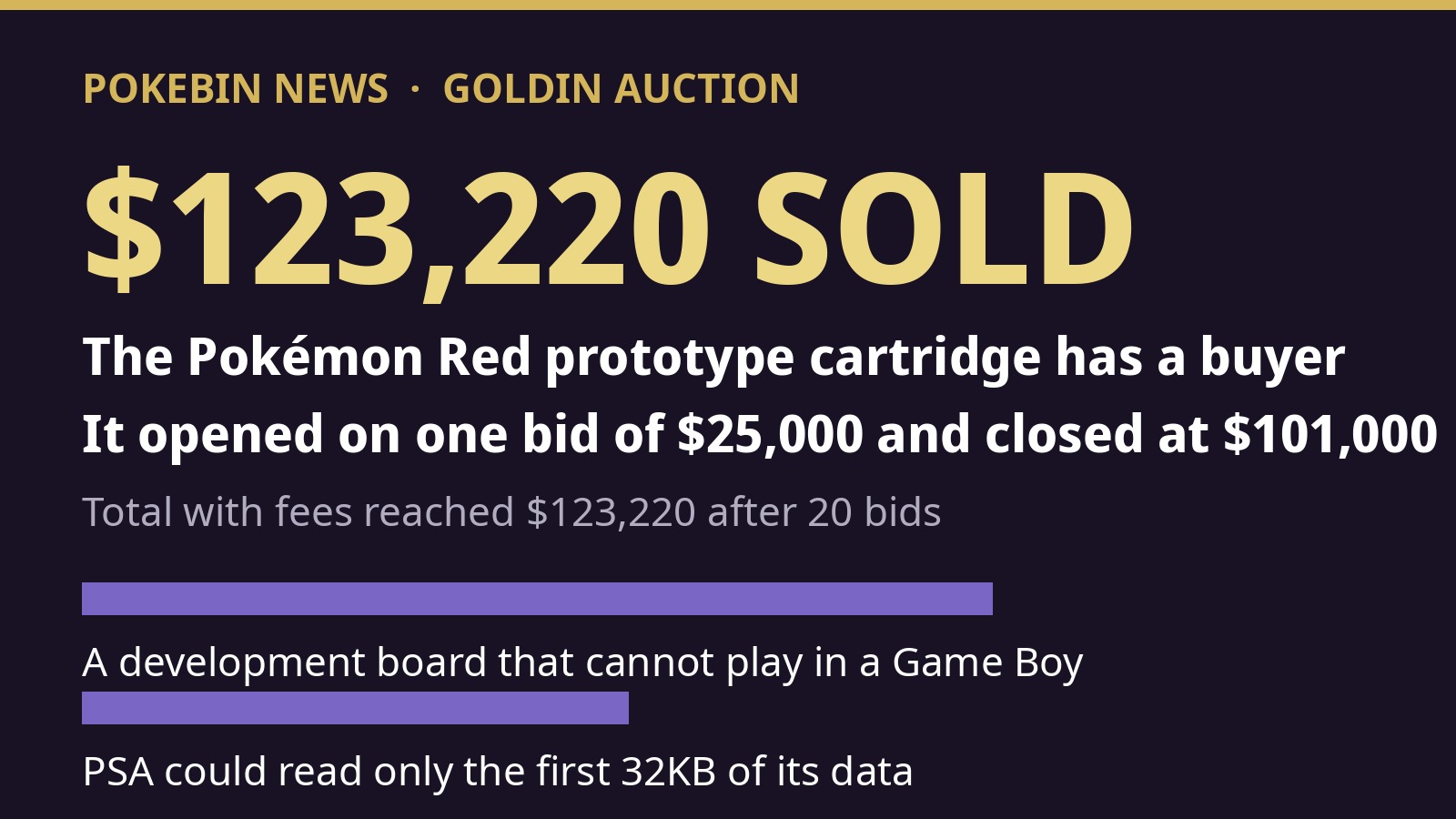
Yesterday this cartridge was a question. Today it is an answer. In our October 25 story we reported a Pokémon Red prototype development cartridge sitting at Goldin on a single bid of 25,000 dollars, and we said the final price would show whether buyers discount hardware that cannot be fully verified. The auction has now closed. Goldin lists the lot at 101,000 dollars, and Dexerto reports the total reached 123,220 dollars once fees were added, after 20 bids. A board that cannot play in a normal Game Boy just sold for more than four times its early bid.
What is new in this story
Everything here is the closing result and nothing else, because the object itself has not changed since yesterday. The cartridge is the 1998 development board Goldin describes as previously undocumented, carrying part number DMG-(F)KGDB-01 and a front sticker reading DMB-MBC-16M-FLASH, encapsulated by PSA with its Pro assessment. What changed is the market verdict. One early bid at 25,000 dollars became a contested auction, and the contest ended at 101,000 dollars before fees. Dexerto notes there is still no evidence of unreleased Pokémon or unused content on the cartridge, so the winning bid was not paid for secret game data. It was paid for the object itself.
The question this sale answers
The open issue yesterday was verification. PSA could read only the first 32KB of data on this board. That readable game data matches the final US release of Pokémon Red, and the only differences PSA found sit in the header data, where the Mask ROM version byte reads 55 instead of 00 and the calculated header checksum reads CB instead of 20. The rest of the data was never read at all, and PSA expressed confidence rather than proof that it would match. Our take yesterday was that a soft result would tell sellers that prototype buyers still discount what cannot be fully proven. The result was not soft. Twenty bids and a six figure total say that at the top of this corner of the market, a partial read from a named grading company and a documented board were enough.
What this means for collectors
Read the price the right way. This is one board, one auction, and one winning bidder, so it is not a price guide for every piece of development hardware in a drawer. What it does establish is a public reference point. A Pokémon development board with incomplete data verification now has a 123,220 dollar completed sale attached to it, and the next seller of similar hardware will open with that number in hand. It also sharpens the split inside game collecting. Playable retail copies of Pokémon Red are common and priced like it. Workshop hardware from the making of the game is scarce in a way no print run can match, and today the market priced that scarcity far above playability.
What to watch next
Watch whether a fuller read of this cartridge ever becomes public. A complete data capture would either confirm that the board holds the finished game and nothing more, or turn a six figure object into a much bigger story. Watch also the next prototype board that reaches a major auction house, because this sale is now the comparison every bidder will bring into the room. If the next one lands near this level on similar paperwork, today was a market signal. If it falls well short, today was one bidder deciding this specific board was the one that mattered.