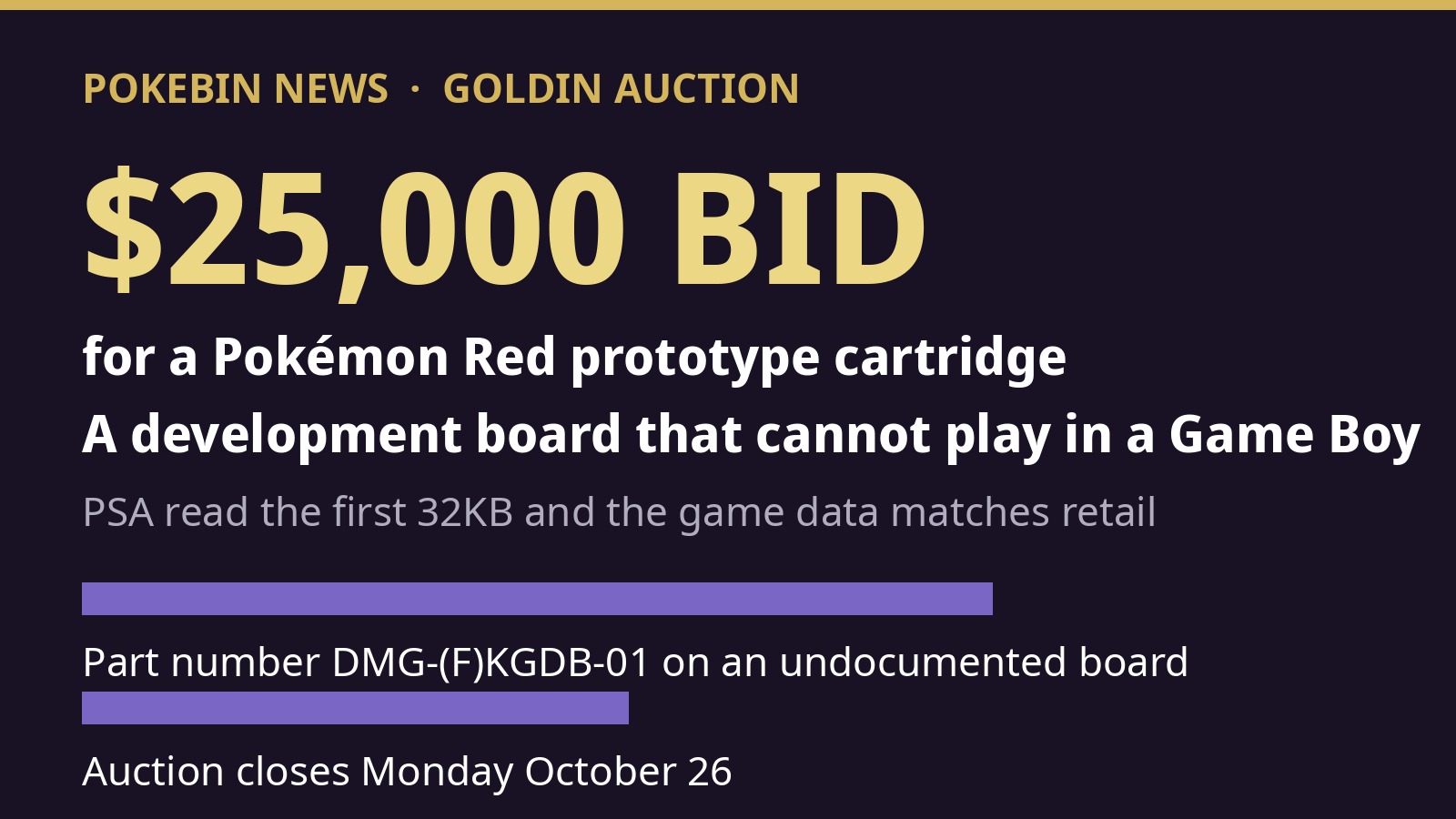
Most auction lots ask you to pay for what an item can do. This one asks the opposite. A prototype development cartridge for Pokémon Red is sitting at Goldin with a single bid of 25,000 dollars, and the cartridge cannot play in a normal Game Boy at all. What a buyer would own is not a playable game. It is a piece of the workshop where one of the best known games ever made was put together, and that distinction is the whole story.
What is actually on the block
Retro Dodo first spotted the Goldin listing and describes the piece as a development cartridge made in 1998. Time Extension reports the same single bid of 25,000 dollars and notes that the cartridge sits in a clear casing, longer than a standard Game Boy cartridge, stamped with the part number DMG-(F)KGDB-01 and carrying a handwritten sticker labeled Red P. Retro Dodo points to a second sticker on the front reading DMB-MBC-16M-FLASH and calls the board an undocumented development board. Nothing about the object looks like retail stock, and that is precisely the point. Development hardware was built for internal work and was never meant to reach the public.
What PSA could verify and what it could not
The honest limits of this lot sit in the PSA notes that Goldin published and both outlets quote. PSA authenticated the piece, but its equipment could not complete a full data read. PSA captured the first 32KB of data and calls that capture technically unique. Two changes appear in the header data and none appear in the game data itself. The Mask ROM version byte sits at 55 where it should read 00, and that single change moves the calculated header checksum to CB instead of 20. Beyond the header, PSA says the game data it could read is completely identical to the final US release of Pokémon Red, and PSA expresses confidence that the rest of the data would match if it could be captured.
Read that carefully before admiring the bid. The strongest claim here is narrow. A partial read matches the finished game, and the remainder is confidence rather than measurement. GigaguideTech adds one more wrinkle worth knowing, noting that the Rare Gaming Dump wiki lists the same board part number for a development cartridge from 2000 with a similar flash chip and a slightly different sticker, so the previously undocumented framing may be stronger than the record supports. None of that makes the piece fake. It means the price is being paid for an object with an incomplete paper trail, and buyers are bidding anyway.
Why a cartridge that cannot play still draws money
Our take is that prototype hardware trades on a different logic than cards or sealed games. A sealed game is valuable because it stayed untouched. A development board is valuable because it was touched constantly by the people building the thing, in rooms the public never sees. Supply works differently too. Retail Pokémon Red sold in the millions and clean copies will always exist. Internal boards were made in small working numbers, most were discarded or destroyed, and survivors surface rarely and without a schedule. When one appears with an auction house listing and an authentication note attached, the small group of prototype collectors does not get many second chances to compete for it.
The risk runs the other way as well. Because the data read is partial and the board has a near match in a community wiki, the final price will say something real about this corner of the market. If the lot climbs well past 25,000 dollars on a partial verification, it tells every holder of development hardware that incomplete documentation is no barrier at the top end. If it stalls at the opening bid, it tells sellers that prototype buyers still discount what cannot be fully proven. Either outcome is information collectors can use the next time a board like this surfaces.
What to watch next
The auction closes on Monday October 26, so the answer arrives fast. Watch the final hammer price rather than the early bid, because a single opening bid at 25,000 dollars only proves one buyer set a floor. Watch also for whether Goldin or PSA publish any fuller read of the cartridge after the sale, since a complete data capture would change what this object is on the record. We will update this story with the closing price when the auction ends.