The certificate check we told buyers to run just got a proper list behind it. Our October 20 story covered the theft of graded cards from a FedEx truck in Santa Ana while the loss was still an estimate built around pallets and a headline value of 963,000 dollars. This follow up covers only what has changed since then. PSA has now counted every missing item, published the full stolen list, brought the FBI into the case, and opened the money side of its response for the owners whose cards never came home.
The count is now exact and Pokémon is the largest share
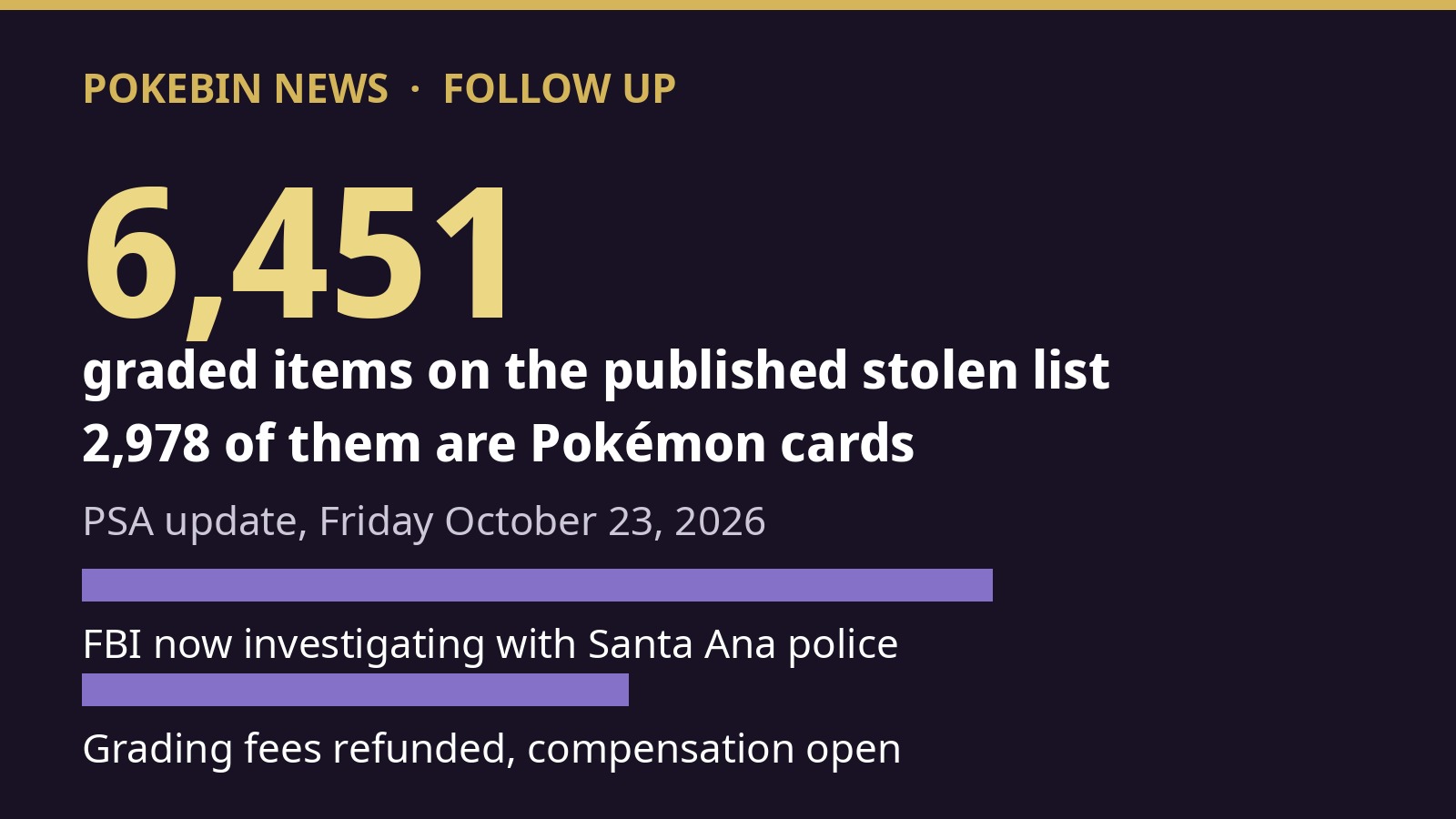
PSA revealed on Friday that the October 13 theft took 6,451 graded collectibles in more than 200 packages that were on their way back to owners after grading. The breakdown of the published list shows where the hobby actually got hit. Pokémon is the single largest category at 2,978 items, and One Piece is the next largest trading card game at 898 items. Basketball at 880 items and baseball at 640 items lead the sports side, while Yu Gi Oh at 58 items, Dragon Ball at 56, Lorcana at 27, Digimon at 16, and Magic The Gathering at 8 round out the game categories on the list. The total value still stands at more than 963,000 dollars as reported by The New York Times and carried in the coverage of the announcement.
That split matters for Pokémon collectors in a practical way. Nearly half of everything stolen came from this one hobby, so the odds that a card from this shipment surfaces in a Pokémon marketplace, a Pokémon group chat, or a Pokémon focused shop are far higher than the original pallet story suggested. The published list includes certification numbers and serial numbers for serialized cards, and PSA has shared it with marketplaces, auction houses, and digital commerce platforms so the items can be flagged if they appear for sale.
The FBI is now investigating alongside Santa Ana police
The criminal case has grown a level. PSA confirmed that the Santa Ana Police Department and the FBI are both investigating, and the company says it has handed investigators video footage, shipment manifests, and item level records. PSA also says it briefed investigators in person at its facility and remains in daily contact with law enforcement. No arrests have been announced, and PSA is asking anyone with information, or anyone affected, to contact the FBI office in Los Angeles.
One short line from the PSA statement sums up where the company says its effort sits. PSA said that recovering every stolen item and returning it to its owner is its top priority. The New York Post adds one detail about the truck itself from authorities, reporting that the vehicle was left unattended for 60 to 90 minutes outside the Santa Ana headquarters while its driver was away and that its lock was broken. Treat that timing as authority reporting carried by the Post rather than a PSA confirmed fact, because PSA has not described how the thieves chose the truck or reached it.
Fees are refunded and compensation is moving
The owner side of the story is where the newest facts help most. PSA says it has begun contacting affected customers and has refunded all grading fees tied to the impacted orders, and it stresses that those refunds are separate from compensation and will not reduce what an owner is owed for a stolen item. Owners whose orders shipped back on a PSA return label are covered by PSA insurance and can start the compensation process now, with payments already going out. Owners who used their own return label will be handled directly by a dedicated PSA team, and anyone who submitted through a dealer is told to contact that dealer.
The New York Post reports that compensation will be based on the fair market value of each item up to the maximum insured value its owner declared, and that owners who accept compensation keep the option to reclaim their cards if the cards are recovered later. That pair of terms is the part affected collectors should confirm in their own messages from PSA, because the declared value cap decided the ceiling long before the truck was opened.
What buyers should do with the list
Our take is that the published list turns a vague warning into a usable tool. Before paying for any graded card that feels freshly listed, oddly priced, or hard to trace, run its certification number against the stolen list and against the PSA database, since every stolen certification number has been deactivated. A deactivated number does not just lower the value of a slab. It marks that slab as a known stolen item, and a seller who cannot explain it has told you everything you need to know.
What to watch next
Watch for the first recovery or arrest announcement from the FBI or Santa Ana police, because more than 200 packages of graded cards are difficult to move quietly now that the list is public. Watch for any recovered items PSA confirms by name, and watch whether compensation timelines hold for owners who shipped on their own labels, since their process runs through direct contact rather than the insured route. If the Pokémon share of the list starts appearing in listings, expect marketplaces to be the first place this case moves next.