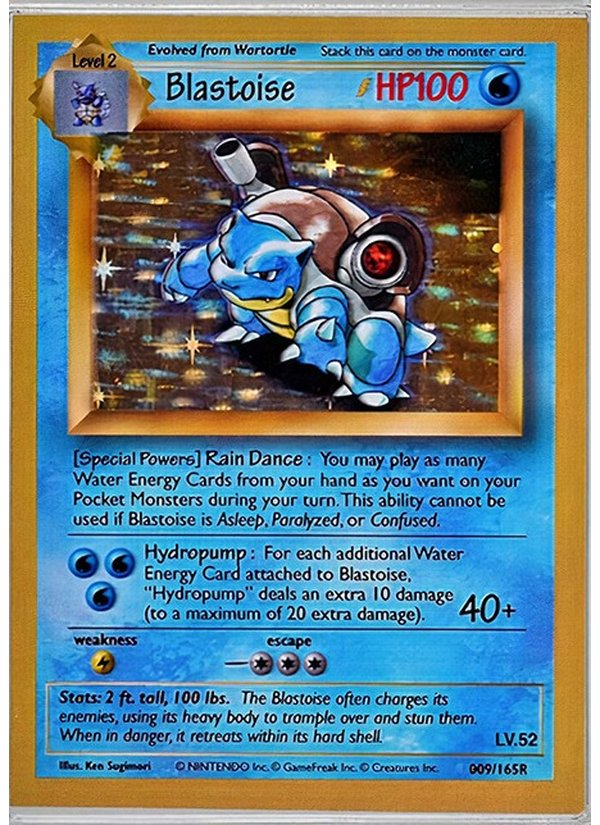
The most important Blastoise in the hobby never came out of a pack. The 1998 Commissioned Presentation Galaxy Holo Blastoise that Wizards of the Coast used to pitch Nintendo of America on bringing the Pokémon Trading Card Game to North America sold for $630,000 at Fanatics Collect on November 20, with the buyer premium included and 59 bids behind it. The copy is graded CGC 8.5, and the result stands as the highest public price ever paid for a Blastoise card.
A pitch piece you can hold in one hand
Everything about this card marks it as a sample built before the English game existed. The corners are square instead of rounded. The back is blank. The artwork carries a Galaxy star holofoil pattern, and the Ken Sugimori illustration is almost identical to the art that later fronted the Pokémon Blue video game box. The lettering also differs from the Base Set printing that followed, because this card was made to sell an idea in a meeting room rather than to sit in a booster pack. Fanatics Collect counts it among the very first English Pokémon cards ever produced.
The supply story is as small as supply stories get. Two presentation Blastoise cards are known to exist. This one was built for the North America pitch. The second was made for an attempt at the international license, and its location and status remain unknown. The CGC census holds exactly one graded copy, and it is the one that just sold.
More than two and a half times the old Blastoise marks
The gap to every other Blastoise is wide. Sports Illustrated puts the earlier high marks at $241,083.60 for a test print Blastoise with a Magic The Gathering card back and at $231,800 for a no rarity symbol Japanese Base Set Blastoise in PSA 10 that sold last December. The presentation card clears both by more than two and a half times. It also has history at the very top of the whole hobby, because the last time this copy sold, in early 2021, it ranked as the second highest Pokémon sale of its moment.
A softer auction and a harder top end
The setting makes the number louder. The Card Calculus recap of the November Premier auction counts 604 lots selling for $39.3 million in total, the lowest monthly total since July and down from $46.5 million in October. Pokémon still carried real weight inside that softer room, with 89 lots making $7.05 million, and Blastoise was not the only Pokémon result with a headline attached. A BGS 10 Pristine Pikachu Gold Star from EX Holon Phantoms made $372,000 on the same night, and a PSA 10 Umbreon Gold Star from POP Series 5 made $312,000.
What this means for collectors
Our read is that the top of this market is splitting in two. Cards bought to be resold quickly are cooling with the wider auction, while objects with a story nobody can print again are still climbing. This Blastoise sits in the second group, because its value rests on provenance rather than on grade alone. A CGC 8.5 would be a compromise grade on almost any other card. On a population of one, with the twin copy missing, the grade is close to irrelevant. The caution from every thin market still applies, because one sale of one copy is a headline first and a price guide second, and no second data point exists to confirm the level.
What to watch next
Watch for the missing twin. If the international pitch copy ever surfaces, the known supply doubles overnight and the hobby gets its first real comparison sale. Watch also whether any other presentation era material reaches a major auction house, because this result tells every holder of early English samples exactly what a documented pitch piece can do in a strong room. And watch the rest of the anniversary year at the top end, because the pattern of 2026 is now hard to miss, with the rarest Blastoise ever offered selling into a cooling auction and still more than doubling its own record book.